
Six industries.
One answer.
Move the material.
Webac has been selling vibration equipment into process industries since 1983. Every industry makes its own demands. Hygiene, ATEX, washdown, cycle time, material traceability. We match the envelope to the job, and we show the calculation.
Construction materials
Compact the concrete, discharge the aggregate, shake out the truck.
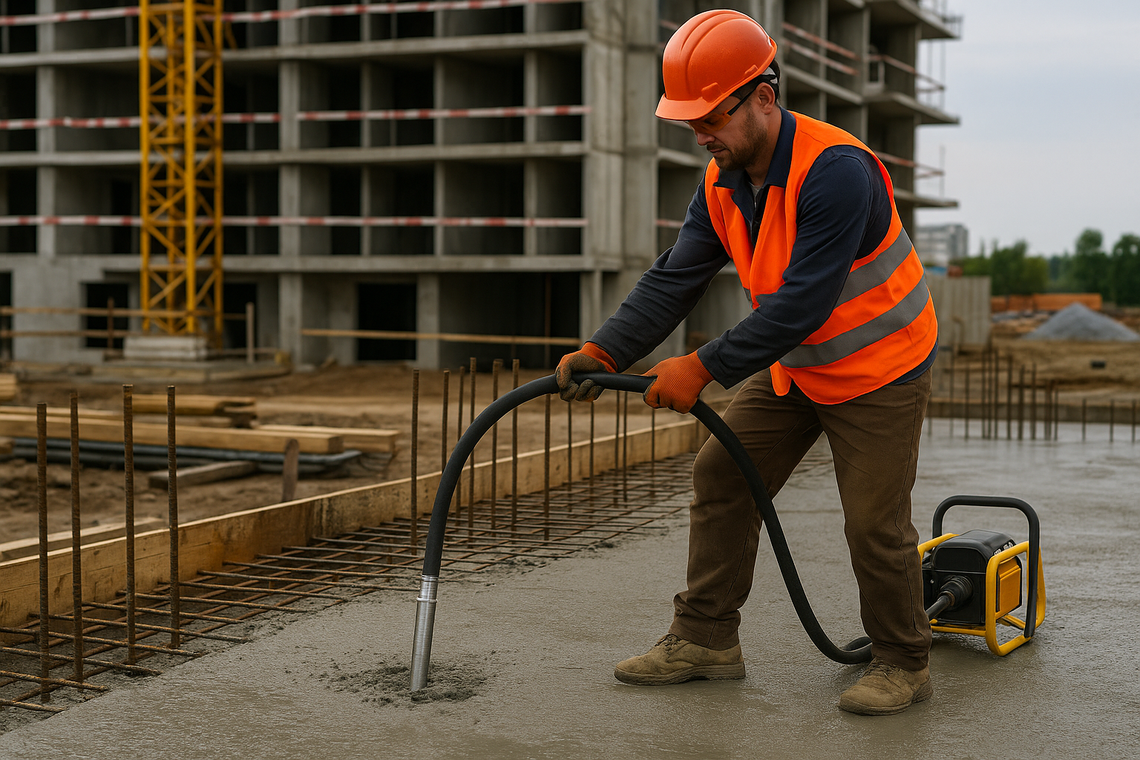
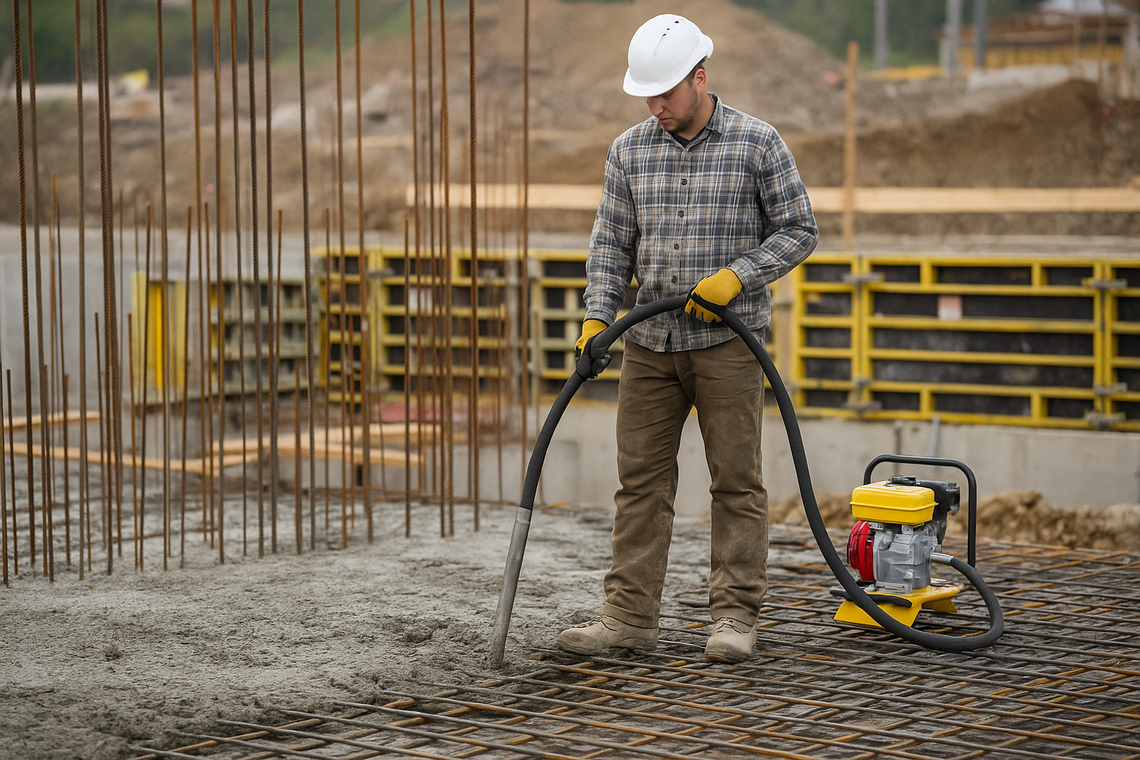
Webac has been a supplier to the precast concrete, ready-mix and aggregate industries since 1983. Internal vibrators for fresh concrete, external vibrators on formwork, hydraulic units on dump truck walls and KONDI-type compaction tables for concrete specimens.
- Formwork vibrators on silo and form walls
- Hydraulic MVO 850 on truck and mixer bodies
- Electric unbalance motors for aggregate screens
- Concrete test tables, DIN EN 12390-2
Pharmaceutical
Hygienic drives, ATEX paperwork, traceable materials.
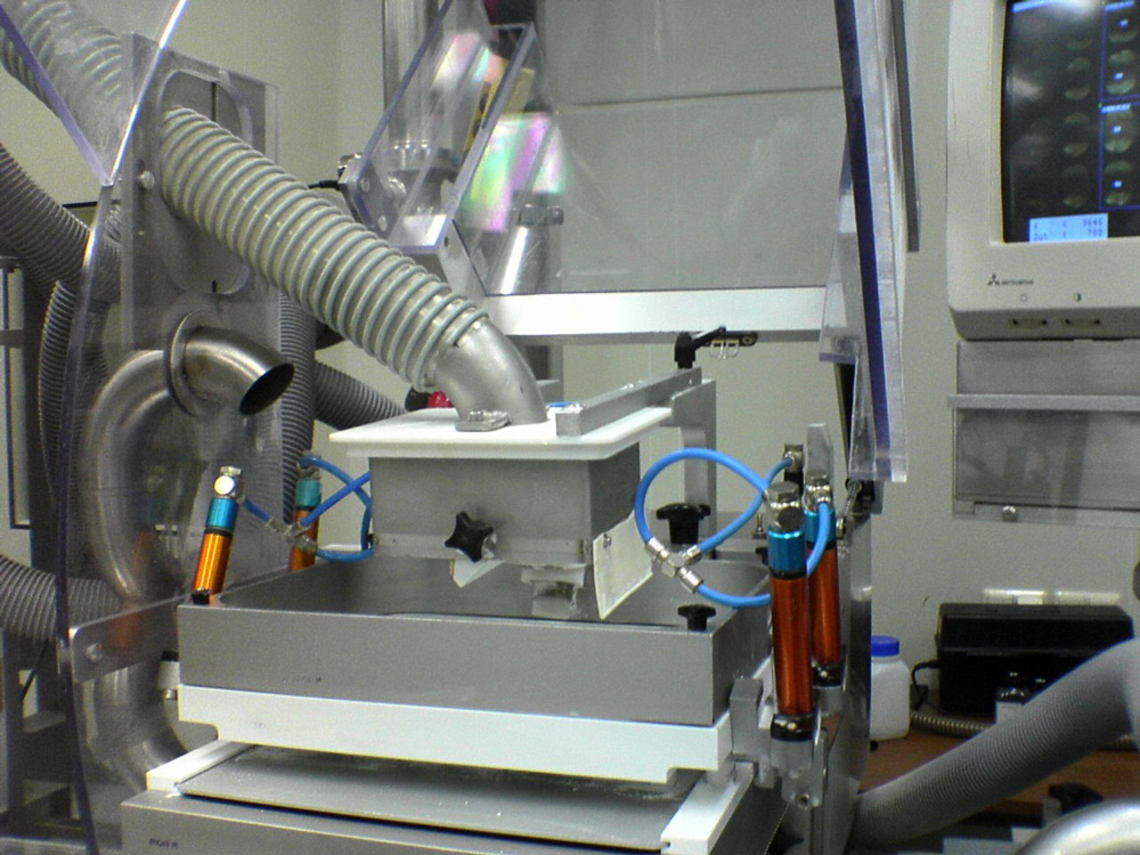
Powder flow and tablet feeding in pharma operations demand hygienic housings, ATEX ratings for zone 21 dust, and a full material traceability file. Webac turbine vibrators and stainless Micro WM motors are the go-to selections.
- Turbine vibrators on blenders and mills
- Stainless Micro WM feeder drives
- ATEX II 2D for excipient dust
- Material certificates 3.1
Food
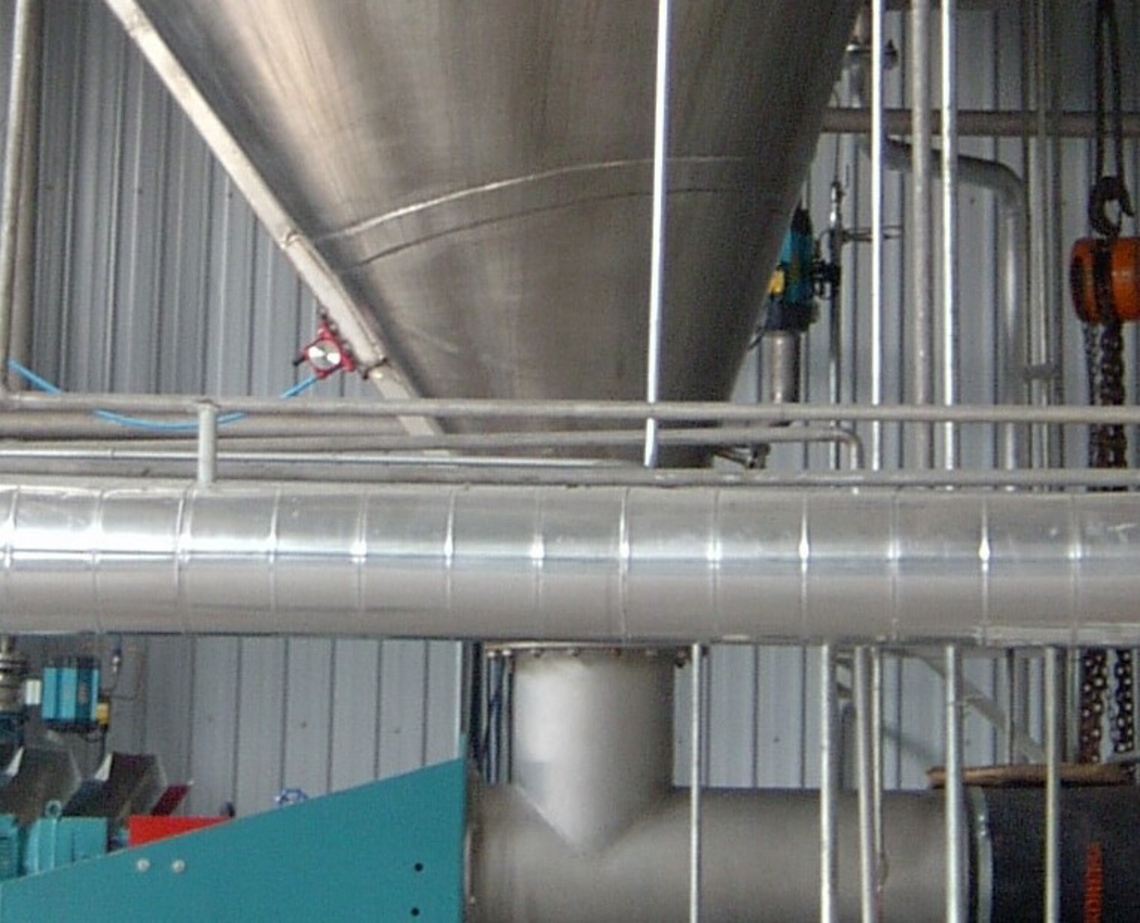
Washdown-ready vibration for grain, sugar, flour and spices.
From flour silos to spice dosing lines, food processors need dependable, cleanable vibration. IP 66 Webac motors survive high-pressure washdown. Oil-free turbine vibrators are the right answer for direct product contact zones.
- IP 66 electric vibrators for silos
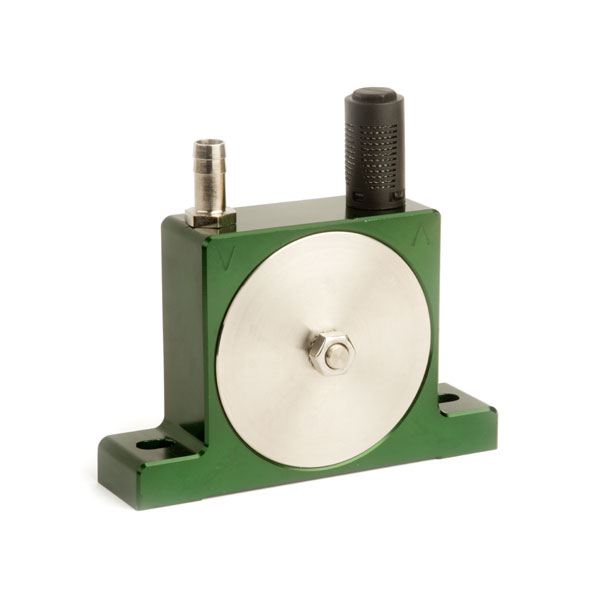
- Oil-free turbine vibrators
- Stainless external vibrators
- Frequency converters in NEMA cabinets
Confectionery and bakery
The KONDI table is a Webac specialty, not a side line.
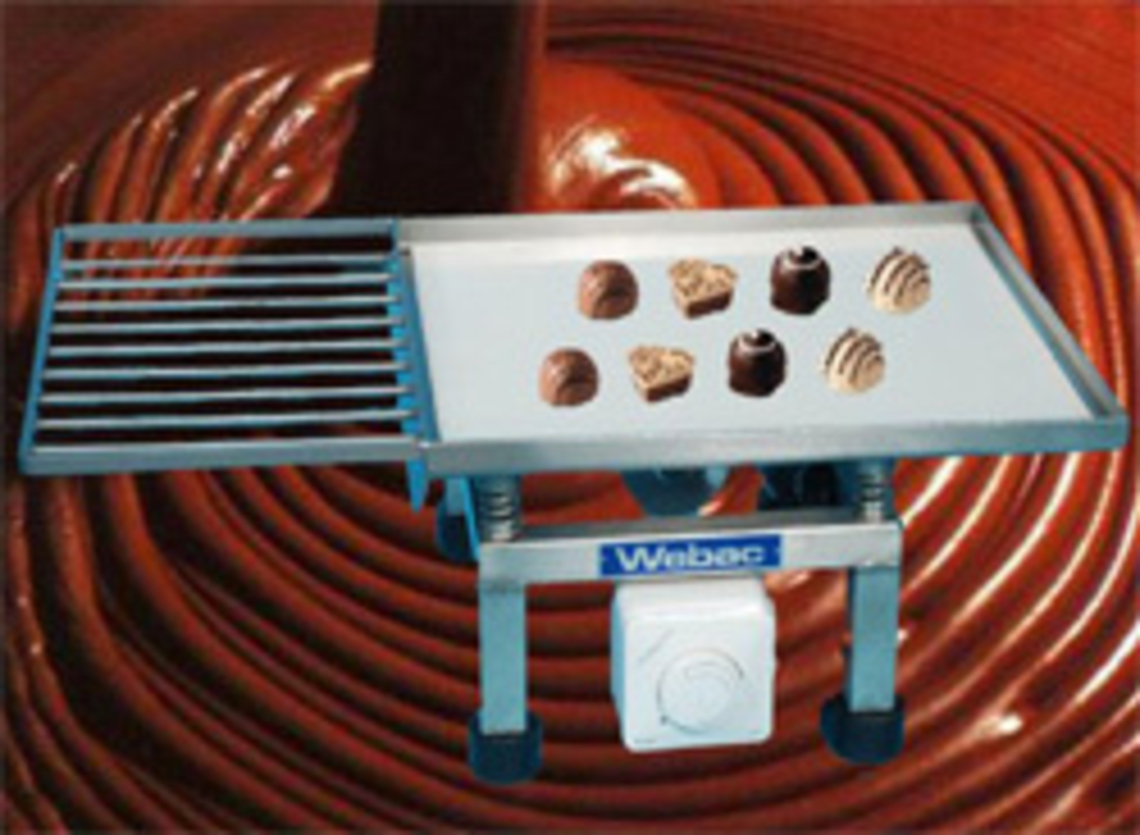
Chocolate, caramel, fondant and jelly all need different frequencies to settle cleanly into moulds. The KONDI lineup exists because confectionery makers asked for something that wouldn't splash the mould or trap air. Custom-tuned per product line.
- KONDI mould-settling tables
- Heated-platen variants
- Gentle ramp control
- Hygienic stainless finish
Packaging
Settle the bag so the pallet stacks.
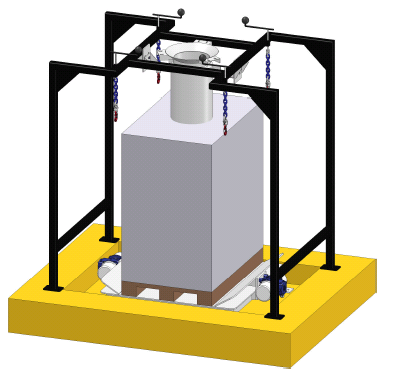
Big-bag, FIBC and drum fillers all live or die on compaction during fill. A slack pallet rejects at receiving. Webac big-bag platforms and underfloor compaction tables sit below the filling chute and let gravity finish the job.
- Big-bag compaction platforms
- Underfloor vibration plates
- Load cell integration
- Pneumatic or electric drive
Water treatment
Move activated carbon, lime and sludge without bridging.
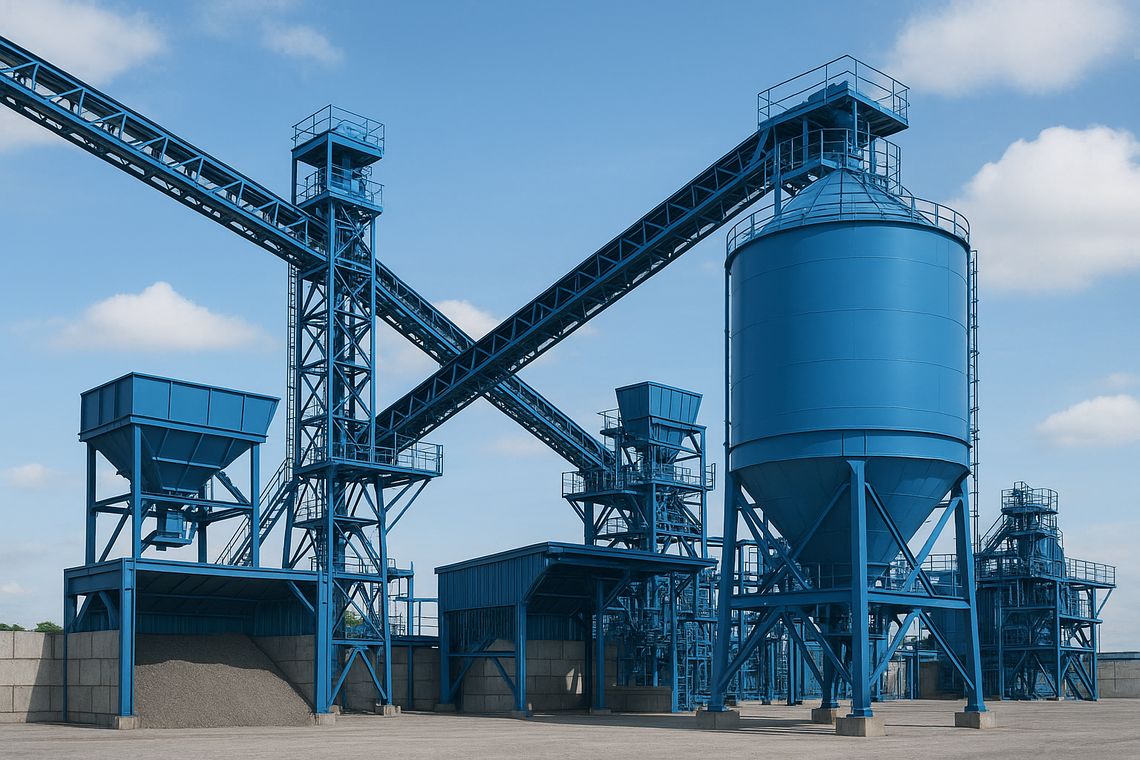
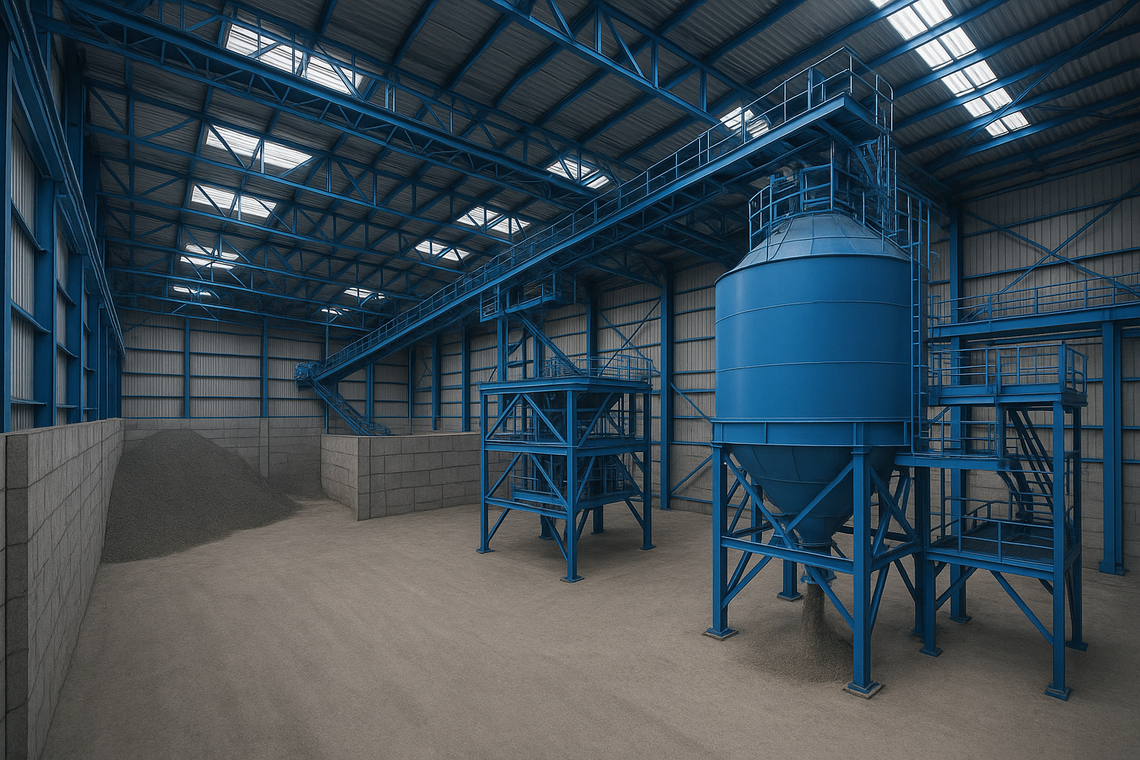
Municipal and industrial water treatment runs on silos of activated carbon, lime and ferric chloride. All of them bridge. Webac external vibrators on the silo wall and electric drives on the feeder restore consistent flow to the process.
- External vibrators on hoppers
- Frequency converters for dosing
- ATEX where required
- Corrosion-resistant housings
What is
vibration?
A moving mass creates energy. Applied vibration technology uses excitation devices (Schwingungserreger) to introduce that energy into a structure in periodically alternating directions, producing oscillation with a specific frequency and amplitude.
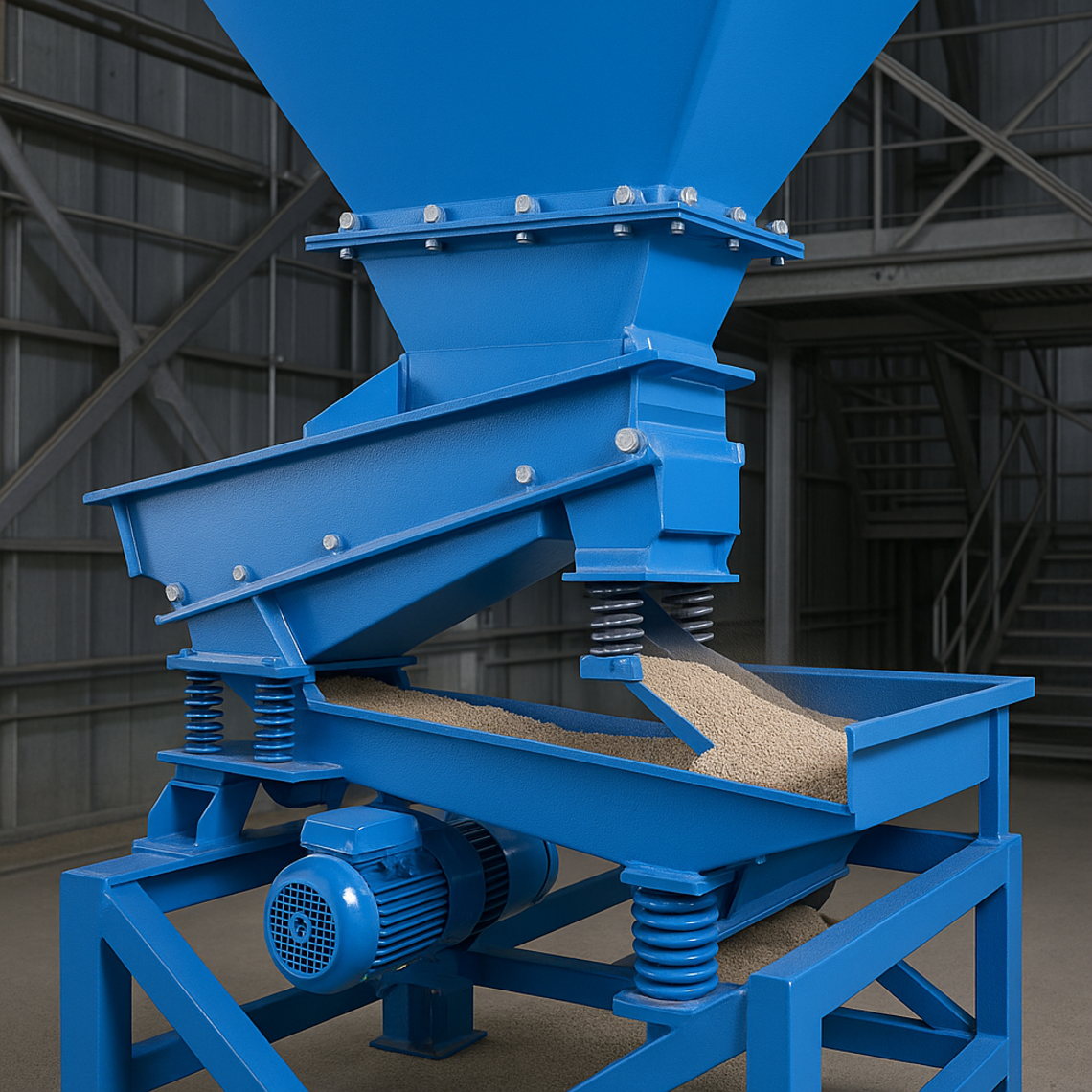
The excited mass describes a circular or elliptical path. Used in unbalance motors, roller vibrators and ball vibrators.
The mass moves back and forth in a single direction. Used in piston vibrators and magnetic vibrators.
Particles are pushed at a specific angle, creating micro-throwing movements and directional migration.
Individual particles are separated from bulk material. Friction reduction causes loosening and flow.
Friction reduction between particles causes rearrangement. Gravity creates greater material density with air removal.
Conveying, dosing, weighing, sieving. Chemistry, mining, machinery, stone and earth materials, smelters, packaging, construction, food, foundries, climate and dust control.
Types of
actuation.
Every vibration application requires a choice between circular and linear motion, and between three energy sources: compressed air, electricity or hydraulic oil.
A single vibrator creates centrifugal force that continuously changes direction. The connected structure describes an elliptical path. Three energy types available:
The mass moves back and forth in a single direction. Two methods to achieve linear motion:
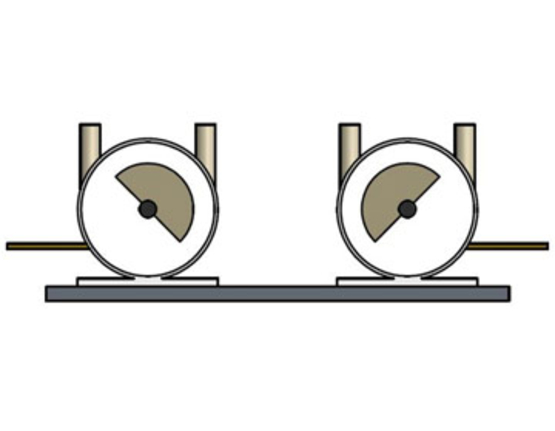
Two circular vibrators rotating in opposite directions on the same plane. Horizontal forces cancel, vertical forces sum. Creates unidirectional vibration perpendicular to the mounting plane.
Seven topics, one shop floor, forty three years.
The same seven questions come back on almost every enquiry. Here are the ones worth reading before you send us a brief.
What is vibration?
The oscillation of a body about a rest position. Measured in Hz, amplitude in mm, and drive power in kW.
Types of actuation
Pneumatic, electric, hydraulic. Each principle suits a different envelope of frequency, power and hygiene.
Conveying
Linear motion moves material from A to B without moving parts in the flow path. Frequency, amplitude and g-factor tables included.
Loosening
Vibration breaks bridges and ratholes in hoppers, silos and big bags. Mounting and g-factor guidance for dry and wet materials.
Compacting
Concrete on slabs, powder in moulds, big bags on pallets. Amplitude tables for 6,000 and 9,000 RPM.
Calculation examples
Worked force calculations, corrected for drive type, with the exact model that delivers the result.
Important information
Advantages and drawbacks of pneumatic versus electric drive. A selection guide on one screen.
Application calculations.
The full reference.
Vibrators are selected first by application, then by frequency. For pneumatic vibrators the approach is different: find the g-factor, the vibrator adapts frequency and amplitude to the structure.
1. Vibrators are selected first by application, then by frequency. This applies especially to electric and hydraulic vibrators.
2. For pneumatic vibrators the approach is different. The main formula is: g x ΣM. With a pneumatic vibrator, you only need to find the g-factor. The vibrator adapts its frequency and amplitude to the structure.
3. Pneumatic vibrators lose frequency under load. Nominal centrifugal forces and frequencies must be corrected using the factors below.
| Vibrator type | Frequency correction | Force correction |
|---|---|---|
| VT Turbine | 0.90 | 0.85 |
| VK Ball | 0.75 | 0.60 |
| VR Roller | 0.60 | 0.35 |
I Fordern Conveying
Conveying, feeding, accelerating, lifting. Applications: conveyor troughs, discharge chutes, conveyor pipes, vibrating chutes, spiral conveyors, vibrating bowls, screens.
Normal frequency: 1,000 to 3,000 min-1 (does not apply to pneumatic vibrators). Frequency depends on the specific gravity of the material particles. Heavier particles require higher frequency.
| Frequency (min-1) | 1,000 | 1,500 | 3,000 |
|---|---|---|---|
| Working amplitude (mm) | 3.5 - 11 | 1.5 - 5 | 0.4 - 2 |
| Extreme max (never exceed) | 25 | 12 | 3 |
g-factor = 1.8 to 2.2 of the total vibrating mass (material + installation + vibrators).
Exception: for horizontal vibration (e.g. screening), these values are halved.
Required force: ΣF (daN) = ΣM x 1.8 to 2.2
ΣM (kg) = Mmaterial + Minstallation + Mvibrators
Transport, dosing, feeding, weighing. 5 to 30 degree inclination. Inclination depends on material weight: heavier = steeper.
Vibration type: linear or directed. Mounting: below the structure.
Max effective range: 2 to 3.5 m per vibrator, depending on structural stiffness.
Sorting, classifying, aligning (bowls). Level bridging (spiral conveyors).
Direction: directed vibration. Mounting: below, to the side, or on the structure.
g-factor values are halved for horizontal vibration (exception: sticky materials).
Vibration type: usually circular, sometimes directed. Mounting: to the side or on the structure.
One vibrator: FR = Fo / √2. Two vibrators in counter-rotation: FR = 2 x Fo / √2. The usable force is FR.
II Losen Loosening
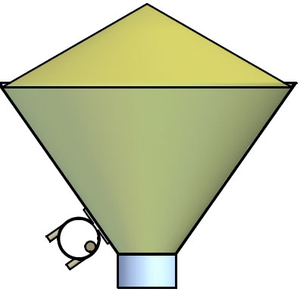
Emptying, de-dusting, loosening, cleaning of sand, lime, cement, coal. Applications: silos, railway cars, truck beds, filters, pipes.
Medium frequency: 1,500 to 3,000 min-1 (does not apply to pneumatic vibrators). 1,500 min-1 for wet or sticky materials. 3,000 min-1 for dry, relatively free-flowing materials.
| Frequency (min-1) | 1,500 | 3,000 |
|---|---|---|
| Working amplitude (mm) | 1.5 - 5 | 0.4 - 2 |
| Extreme max (never exceed) | 12 | 3.5 |
g-factor = 1.8 to 3.5 of the vibrating mass (material in silo cone, or structural mass).
Required force: ΣF (daN) = ΣM x 1.8 to 3.5
Force direction: perpendicular to the vibrating structure (horizontal or diagonal).
Vibration type: usually circular, sometimes directed. g-factor: usually 2 is sufficient for cone angles up to 30 degrees. Above that, apply correction factors.
Mount on one third of the cone length. Vibrator must be fixed to a steel reinforcement.
Recommended: pneumatic turbine, ball or piston vibrators. Electric vibrators for larger installations. Use ATEX-rated vibrators in dusty atmospheres.
Filters, pipes, screens, foundry moulds. Direction: perpendicular to the structure.
Vibration: usually circular, sometimes directed. Max 1,500 min-1 for electric (exception: pipe cleaning requires high frequency).
g-factor loosening/cleaning: 2.0 to 2.5 of total vibrating structure mass. Foundry moulds: 2.5 to 3.0.
Values halved for horizontal vibration. Mounting: to the side of the structure.
III Verdichten Compaction
Filling, compacting concrete. Applications: packaging of bulk goods (powder, graphite, quartz flour, granulate), mould preparation (foundries), concrete compaction.
High frequency: 6,000 to 9,000 min-1 (does not apply to pneumatic vibrators). 6,000 min-1 for most materials and concrete. Up to 9,000 min-1 for very fine-grained materials. Exception: 3,000 min-1 for very dry concrete.
| Frequency (min-1) | 6,000 | 9,000 |
|---|---|---|
| Working amplitude (mm) | 0.3 - 0.4 | 0.2 - 0.25 |
Industry (filling):
g-factor = 0.8 to 1.5 of total vibrating mass. Enables up to 20% additional cubic volume.
Construction (concrete):
Highly variable depending on formwork and mould type. Contact the factory for application-specific values.
Enables up to 20% additional cubic capacity. Force direction: upward (vertically).
Vibration: circular, high frequency 6,000 to 9,000 min-1 depending on particle size (finer = higher). Mounting: below the mould or structure.
Stone blocks, formwork. Force direction: upward.
3,000 min-1. g-factor: up to 1.5, exceptionally 2.5.
Worked examples.
100 kg base mass.
Four worked sizing calculations from the Webac catalogue. All assume a total vibrating mass of 100 kg. Electric and pneumatic paths shown side by side with correction factors applied.
Fordern (Conveying)
2.0 × 100 = 200 daN
WEV 10/02/4
200 / 0.85 = 235 daN
VT 24
Note. Working frequency 1,500 min⁻¹. The 0.85 correction applies to VT-type pneumatic vibrators under load.
Losen (Loosening)
2.7 × 100 = 270 daN
WEV 10/14/2
270 / 0.85 = 318 daN
VT 31
Note. Working frequency 3,000 min⁻¹. Higher g-factor for loosening wet or sticky bulk solids from silo walls.
Verdichten (Compaction)
1.2 × 100 = 120 daN
WEV 05/14/2
120 / 0.85 = 141 daN
VT 16
Note. Working frequency 3,000 min⁻¹. Lower g-factor reflects the lighter duty of settling and compaction.
Cross-type substitution (VT to VK and VR)
VT 24 → VK 26 (200/0.6 = 334 daN) or VR 78 (200/0.35 = 572 daN)
VK 26 / VR 78
VT 16 → VK 22 (121/0.6 = 201 daN) or VR 47 (121/0.35 = 346 daN)
VK 22 / VR 47
Note. Any VT selection can be swapped for a VK (ball, factor 0.60) or VR (roller, factor 0.35) by dividing the base force by the respective correction factor.
Formulas taken from Webac's public Anwendungsbeispiele Kalkulation. The centrifugal force target F is calculated from the g-factor times the mass to be moved. For VT type pneumatic vibrators, divide the result by 0.85. For VK types, divide by 0.60. For VR types, divide by 0.35.
Important information.
Air or electric, not both.
The most common question on every application call: should this site run pneumatic or electric vibrators? Here is the short version, drawn directly from the Webac catalogue.
Pneumatic drive
- Very flexible: frequency and amplitude adjustable on the fly
- High frequency for fine materials
- Explosion-safe in dust atmospheres
- Temperature-safe up to 200°C with UCV-type units
- Runs on compressed air, which is already in most plants
- Small installation envelope
- Higher energy cost per hour of run time
- Louder than electric, except VT type at max 70 dBA
- Roller vibrators need oiled compressed air supply
Electric drive
- Energy efficient, clean, quiet
- Adjustable centrifugal force via eccentric weights
- Broad power range from 0.05 kW to 22 kW
- Works directly from site mains
- Less flexible: frequency fixed by pole count
- Not intrinsically explosion-safe without ATEX rating
- Temperature-sensitive above 50 to 70°C
- Larger installation envelope
Content paraphrased from Webac's own Wichtige Hinweise page. The catalogue goes into more detail on temperature envelopes, ATEX ratings per zone, and frequency tuning per material.
Foundries, mining,
chemical, paper, steel.
These six industry pages are the ones with the longest track record. Webac equipment runs in foundry shakeout, mining screens, chemical reactor zones, paper machine screens and steel mill conveyor lines as well. Ask us and we'll point you at the nearest reference.
Named reference customers and detailed case studies per industry available on request.